
School Funding

Source: National Catholic Education Commission (School Funding – NCEC)

Under the Australian Education Act 2013 and NT Education Act all Approved Authorities, including NT Christian Schools, must fund schools and students according to a needs-based funding arrangement (NFBA)

In our role as the Approved Authority, NT Christian Schools (NTCS) received funding that helps educate approximately 1300 students who attend one of our seven schools. These are located in metropolitan, regional and remote areas across the Northern Territory. These campuses are operated as:

  1. Araluen Christian College
  2. Gäwa Christian School
  3. Marrara Christian College
  4. Nhulunbuy Christian College
  5. NT Christian College
  6. Palmerston Christian College
  7. Sattler Christian College

These schools come under the control of the NTCS Board and form part of the Christian Education National (CEN) Network. The combination of these campuses provides teaching and learning from Transition to Year 12 , Early Learning Centres, and Indigenous boarding. There are approximately 1300 students enrolled in NTCS.

NT Christian Schools Funding Principles

Christ-Centred Focus

Our funding is dedicated to supporting education that reflects Christian values, helping children grow academically, spiritually, and socially in a nurturing environment.

Accessibility for All Families

We aim to ensure that all families, regardless of their financial situation, can consider NT Christian Schools for their children. We aim to make support available for those in need, including families in remote areas, Indigenous communities or those facing unique financial circumstances.

Supporting Diverse Communities

The Northern Territory is home to a rich variety of cultures and communities. Our funding recognises these differences and ensures every child, no matter where they live, receives the same high-quality education.

Our funding must address the unique challenges of rural and remote schools, providing additional resources where needed to ensure equity in education delivery.

Respect for Indigenous Culture

We value and celebrate the contributions of Indigenous families to our school communities. Funding helps support programs that incorporate Indigenous knowledge, languages, and traditions into learning.

Responsible use of Resources

We are committed to using resources wisely, focusing on sustainability and making decisions that benefit students now and into the future.

Funding should support sustainable infrastructure, energy-efficient practices, and innovative educational initiatives that align with long-term goals.

Needs-Based Funding

Each school community is different, and our funding ensures that the specific needs of students are met.

We align funding distribution with the specific needs of each school, prioritising areas with limited access to resources or higher concentrations of disadvantaged students, including English as an Additional Language or Dialect (EAL/D) learners.

Parent Choice and Affordability

We work hard to keep tuition fees affordable for families, offering financial support and payment options to make Christian education accessible.

Funding arrangements must support parents’ freedom to choose NT Christian Schools for their children’s education. This includes ensuring tuition fees remain affordable through advocating for increased government subsidies and community support.

Holistic Student Development

Our schools are places where children grow not only academically but also emotionally, physically, and spiritually. Funding supports programs that encourage students to thrive in every area of their lives.

Investment in NT Christian Schools should foster academic, spiritual, physical, and emotional growth. Resources should support extracurricular activities, counselling services, and student well-being programs.

Transparent and Accountable Practices

Schools must maintain transparency in the allocation and use of funds. Reporting mechanisms should ensure stakeholders, including families, donors, and government bodies, have confidence in the school’s financial stewardship.

Partnership with Governments and Community

NTCS engages in constructive relationships with government agencies and community organisations to secure funding that complements the unique mission of NT Christian Schools. Collaborative efforts should address shared goals, such as literacy, numeracy, and teacher development.

This provision of additional resources and programs benefit our students and families.

Commitment to Teacher Excellence

Great teachers are at the heart of every school. Funding ensures that our educators receive the training and support they need to provide exceptional care and education for every child.

We will invest in professional development, recruitment, and retention of teachers who share the schools’ Christian ethos. Funding should support training in culturally responsive teaching, digital literacy, and innovative pedagogies.

Future-Oriented Education

Our schools focus on helping children succeed in a changing world, whether through STEM programs, vocational pathways, or opportunities to grow their unique talents.

Prepare students for lifelong success through funding initiatives that promote university entry, STEM education, career pathways, and vocational training tailored to the NT context.

OR:

  • Christ-Centred Focus: Investment supports Christ-centred education and whole-child growth.
  • Accessibility for All Families: Financial support ensures education is accessible for all families, including those in need.
  • Supporting Diverse Communities: Resourcing provides equitable, high-quality education across all communities.
  • Respect for Indigenous Culture: Investment supports and embeds Indigenous culture, language, and knowledge.
  • Responsible Use of Resources: Allocated resources are used wisely for sustainable, long-term outcomes.
  • Needs-Based Funding: Financial allocation is directed based on the specific needs of each school community.
  • Parent Choice and Affordability: Support mechanisms help keep fees affordable and uphold parent choice.
  • Holistic Student Development: Investment enables academic, spiritual, physical, and emotional growth.
  • Transparent and Accountable Practices: Financial stewardship is maintained with transparency and accountability.
  • Partnership with Government and Community: Resourcing is strengthened through collaboration with government and community.
  • Commitment to Teacher Excellence: Investment drives teacher development and retention.
  • Future-Oriented Education: Strategic investment supports programs that prepare students for future pathways.
What is needs based funding?

Needs-based funding is a method that ensures funds are distributed to schools in an equitable way. This is done in accordance with legislation that supports the individual needs of a school and its students.

All schools begin with a standard amount for any student in Australia – with one amount for primary schools and another for secondary schools.

The Commonwealth Government specifies an amount known as the Schooling Resources Standard (SRS) – otherwise known as “base funding”.

How are schools in the NT Christian Schools system funded?

NTCS schools are funded through Commonwealth and Territory School Resource Standard (SRS) funding, school fees and donations.

In 2026, we will receive a forecast of $43.1m from:

  • $29.1m in Australian Government Funding
  • $6.6m in NT Government Funding
  • $7m in school fees from the schools that make up NTCS
  • $0.4m in private income, donations and investments

Who Pays for School Education?

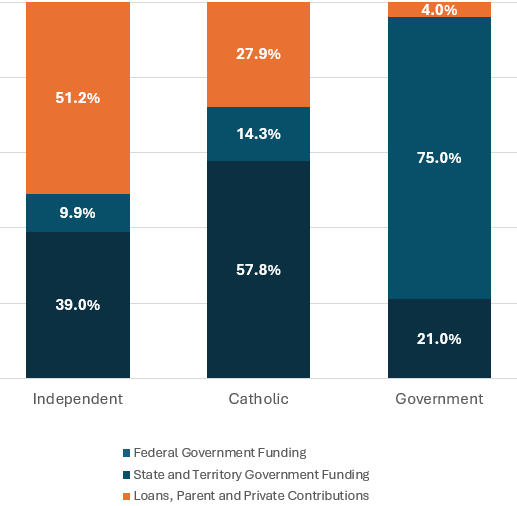
Responsibility for the recurrent funding of education is shared by the Australian Government, state and territory governments, and parents and non-government school communities.

The Australian Government provides less than half of per student funding for Independent Schools, making private income the principal source of independent schools’ funding. NT Christian Schools comes under the Independent Schools category.

Government school students are mainly funded by governments, with state and territory governments contributing more than 95% of total per student funding for government schools.

There are significant recurrent costs attached to educating children and young people in all Australian schools.

In 2026, the minimum (or “base”) recurrent cost of school education for every Australian student is:
• $14,439 for a primary student, and
• $17,581 for a secondary student


Students in priority cohorts and disadvantaged schools attract higher amounts of funding to respond to specific needs and enable priority students to achieve their full potential.


Per student recurrent funding must be spent directly on recurrent costs, including students, staff and operating costs. It cannot be spent on capital expenditure for example a new building.
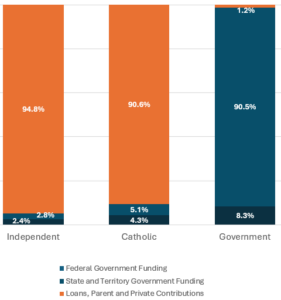
In addition to the cost of educating students (called recurrent funding), schools incur additional costs for classrooms, libraries, sports facilities, and other capital projects (called capital expenditure).

Independent and Catholic school parents and communities must raise the costs of capital projects privately, although disadvantaged schools can apply for assistance through government grants. In contrast, government school capital costs are mainly funded by state and territory governments with a small contribution from parents.

In 2025, NT Christian Schools invested $5.5 million on capital projects.
The SRS benchmark establishes the minimum cost – known as ‘Base Funding’ – of educating a student. Every student regardless of where they go to school gets the same base funding – $14,439 for a primary student and $17,581 for a secondary student.

Non-government schools are then means tested to determine how much the parents of students are expected to contribute – known as the ‘Capacity to Contribute’ – and government funding is then reduced accordingly. Six priorities then receive additional funding – known as ‘Loadings’ – to support students with disability, Aboriginal and Torres Strait Islander students, socio-educational disadvantage, low-English proficiency, as well as disadvantage due to school size and school location. 
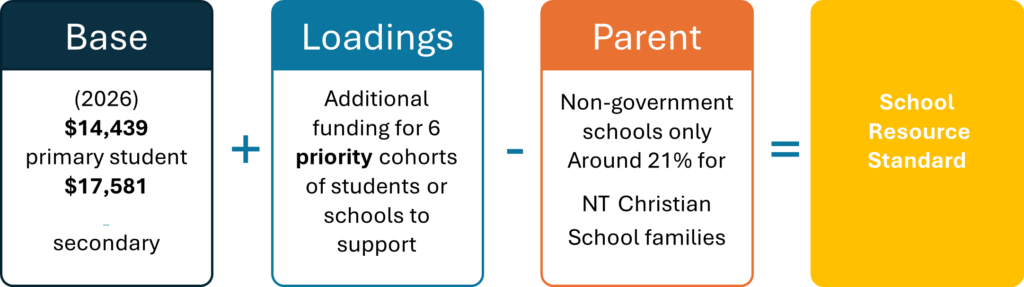
For non-government schools, including NT Christian Schools, the base amount of funding is reduced based on a school community’s Capacity to Contribute (CTC) to the operating costs of the school.

The CTC measures the capacity of the parents or guardians of students to contribute to the cost of educating their children. Wealthier communities receive less Government funding.

Additional funding called “Loadings” are added to base funding for students in priority cohorts and disadvantaged schools to address specific needs that individual students face. Loadings are not reduced by non-government school capacity to contribute, so that students in priority cohorts can attract the same loadings regardless of the schools they attend.

Four types of students and two types of schools attract loadings:

  • Students with disability
  • Aboriginal or Torres Strait Islander students
  • Students with low English proficiency
  • Students facing socio-educational disadvantage
  • Regional and remote schools
  • Small schools

Transition

  • Every school in Australia is moving to the Schooling Resource Standard (SRS).
  • However, some schools are currently funded above the SRS for historic reasons, and some are funded below the SRS.
  • Governments have agreed to a transition period to enable schools to adjust to the SRS funding.

In 2020 all schools began transition to the new funding model with full alignment to SRS funding expected by 2029. All NT Christian Schools campuses will not see this new funding until 2029 while government schools are seeing an incremental increase to funding every year up to 2029.

How are the funds distributed?

After CSNSW receives the recurrent funding from government, funds are distributed to its 7 schools via a 2-step process:

  • Step 1: As an Approved System Authority, we centrally pool all government funds before distributing them to 7 schools within the NT.
  • Step 2: NTCS then deploy or allocate the funds to each of the schools based on local knowledge of the school and its community.

How is the funding used?

The funding we distribute to schools is spent – or committed to be spent – on eligible school-related items in the year it’s received.

Funding covers schools’ operations, including:

  • salaries – principals, teachers and support staff
  • operating costs – including administration, marketing, IT and accounting
  • property expenses – including maintenance and utilities
  • debt servicing costs
  • capital equipment.

Funding for capital projects such as new buildings or other major infrastructure projects are funded mainly from parent fees and other contributions.